Smart Home Technology Trends in the Bay Area
The Bay Area has always moved fast on technology adoption, and residential smart home systems are no exception. What started with a few connected bulbs and a voice speaker has shifted into something far more ambitious: whole-home platforms that tie together lighting, audio, security, climate, and more under a single interface. Here is what is actually gaining traction in Bay Area homes right now.
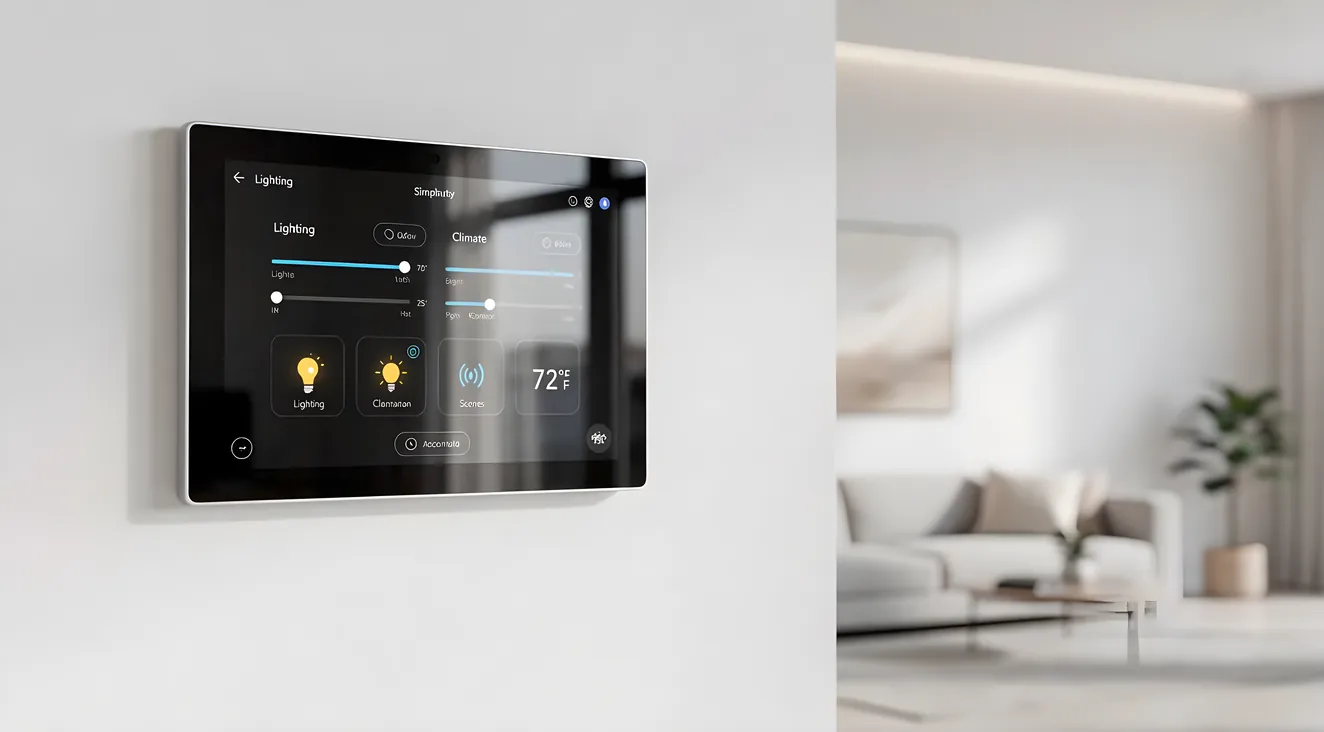
Unified Control Platforms Are Replacing Standalone Devices
A few years ago, homeowners would layer together a Philips Hue app, a Nest thermostat, a Ring doorbell, and a handful of voice routines, each running in its own silo. That approach is falling out of favor for anyone investing seriously in their home.
Control4, Savant, and Crestron have become the dominant platforms for full-home home automation in the Bay Area market. These systems do not replace individual devices so much as they absorb them into a single control layer. One app, one interface, one remote, whether you are adjusting the living room lighting or checking on a guest arriving at the front gate.
Bay Area homeowners tend to be comfortable with platform complexity in a way that homeowners in other markets are not. Many of them manage multi-product technology stacks professionally, so the concept of a hub-and-spoke architecture for their home is intuitive rather than intimidating. That familiarity accelerates adoption and pushes integrators toward more sophisticated builds.
For homeowners considering this path, the key decision point is not which platform to choose but which integrator has the deepest experience with it. These systems require proper programming, not just installation, and the quality of that programming determines the day-to-day experience.
Lighting Control Beyond Smart Bulbs
Lutron has been the gold standard for residential lighting control for decades, and that has not changed. What is changing is how it is being used.
Ketra, which Lutron acquired in 2018, brought tunable white and full-color capability to architectural fixtures. Combined with Lutron's Homeworks QS or RadioRA 3 platforms, this enables what the lighting industry calls human-centric lighting: systems that shift color temperature and intensity across the day to support natural circadian rhythms.
Warmer, lower-intensity light in the evening. Cooler, higher-intensity light in the morning. The change is subtle but the impact on sleep and daily energy levels is real, and Bay Area homeowners who care about wellness are paying attention.
This category is particularly active in new construction and high-end remodels. Builders and designers working in Marin, the Peninsula, and the East Bay hills are increasingly specifying Lutron from the start rather than treating it as an add-on.
For existing homes, retrofitting lighting control is more involved but not impossible. A good integrator will assess existing wiring and fixture compatibility before speccing a solution.
Whole-House Audio Continues Growing
Distributed audio has been around long enough that the category feels familiar, but the technology has improved significantly. The platform many homeowners know dominates the mid-market because it is reliable, well-supported, and genuinely good. For larger builds, dedicated multi-zone amplifiers paired with in-wall or in-ceiling architectural speakers remain the preferred approach.
What is notable in the Bay Area specifically is the indoor-outdoor audio demand. The climate in most of the region makes outdoor living viable for nine or ten months of the year. Patios, decks, and gardens get used constantly, and homeowners want music to move with them from kitchen to patio to poolside without fumbling with Bluetooth handoffs.
Weatherproof architectural speakers, properly waterproofed wiring runs, and integration into the whole-home audio controller make that experience work. A well-designed system means the transition is invisible: the music follows you.
Multi-zone distribution also matters for homes where different people have different listening preferences at the same time. A teenager in one room, a home office call in another, and dinner preparation in the kitchen all coexist without interference when the system is designed correctly.
For more on how audio fits into broader home automation systems, that resource covers the integration in more depth.
Security Integration with Home Automation
Security systems have traditionally sat apart from the rest of the smart home. A separate panel, a separate app, a monitoring service that operates on its own. That is no longer the expected standard for higher-end builds.
Modern security integration means cameras, door locks, access control panels, and alarm monitoring all surface through the same control interface as lighting and audio. Lock the front door from the same app you use to dim the living room. Get a camera view on the control panel when the doorbell rings. Trigger lighting scenes when the alarm trips.
This matters particularly for Bay Area homeowners with second properties. Napa Valley homes, Lake Tahoe cabins, and Sonoma county ranches often sit empty for stretches of time. Remote monitoring through a unified smart home security platform gives owners visibility and control without being physically present. Motion alerts, door open events, and camera feeds all arrive in real time.
The integration also improves response quality. When a security event triggers, the system can automatically turn on exterior lights, unlock specific doors for first responders, and log timestamped video, all without manual intervention.
The caveat is that integration quality varies significantly by installer. A security system bolted onto a home automation platform as an afterthought behaves differently than one designed into the architecture from the beginning.
Energy Management
California electricity rates make energy management a financial priority in a way that is unique to this market. Pacific Gas and Electric's time-of-use pricing means the cost of running appliances varies by several multiples across the day. Smart systems that respond to those pricing signals can meaningfully reduce utility bills.
Smart thermostats are the entry point, and integrators building full systems typically fold thermostat control into the main automation platform rather than leaving it as a separate app. That allows climate control to coordinate with other systems: lower the shades when the sun hits the west-facing windows, pre-cool the house before peak pricing hours begin, adjust setpoints based on occupancy sensing.
Motorized shades are another energy management tool that doubles as a comfort feature. On hot days, closing shades on sun-exposed facades significantly reduces cooling load. On mild days, opening them brings in natural light and warmth. Automated shades that respond to sun position, temperature, and time of day handle this without manual adjustment.
Solar integration is increasingly common across the Bay Area. Homeowners with solar and battery storage want their automation system to be aware of production and storage levels. Priorities shift based on whether the home is drawing from the grid, running on stored power, or exporting surplus.
What This Means for Bay Area Homeowners
The common thread across all of these trends is integration. Individual products have become more capable, but the value compounds when they work together under a single system.
For homeowners planning a new build or major remodel, the right time to think about home automation infrastructure is before the walls close. Conduit runs, network drops, dedicated circuits, and equipment room space are far cheaper to address during construction than after. An integrator brought in at the design phase can specify what is needed before the general contractor pours the slab.
For homeowners in existing homes, the situation is more nuanced. Some retrofits are straightforward. Lighting control, for example, can often be done without rewiring by using wireless systems. Others require more significant work. The realistic starting point is a conversation with an integrator who will assess what is feasible and what the actual cost and disruption will be.
Future-proofing matters here more than in most home improvement categories. The devices and platforms that exist today will evolve. A well-designed system built on an established platform with proper network infrastructure will adapt to that evolution. A collection of consumer gadgets taped together with app integrations probably will not.
Finding the right installer for your project starts with understanding what you want the system to do and matching that to someone with verified experience delivering it. This directory covers Bay Area integrators working across all of these categories.