Home Theater Installation in the Bay Area
This page covers what's involved in a professional home theater installation and what to look for when hiring an AV integrator in the Bay Area. Whether you're converting a spare room or adding surround sound to an existing living space, these details help you ask the right questions and compare companies accurately.
What Home Theater Installation Includes
A professional installation is more than mounting a TV and running speaker wire. It starts with a room assessment: dimensions, wall materials, ambient light sources, HVAC noise, and existing wiring. Those factors drive every decision that follows.
Equipment selection comes next. A good installer walks you through display options (projector vs. flat panel), screen sizes calibrated to your seating distance, AV receivers, speaker configurations, and source components. They're not selecting from one brand's catalog but matching gear to your actual room and how you plan to use it.
Wiring runs before anything goes on the wall. Conduit for future-proofing, HDMI and speaker wire routed through walls or ceiling, subwoofer placement to minimize standing waves, and power conditioning to protect the investment. This is the part that separates a clean, professional build from a tangle of cables behind the furniture.
Speaker placement and calibration close out the job. Position matters for surround imaging, and every receiver has an automatic calibration system (Audyssey, Dirac, YPAO) that the installer runs after placement is locked in. A room treatment discussion often follows: bass traps, acoustic panels, and diffusers can solve problems that no amount of EQ will fix.
Types of Home Theater Projects
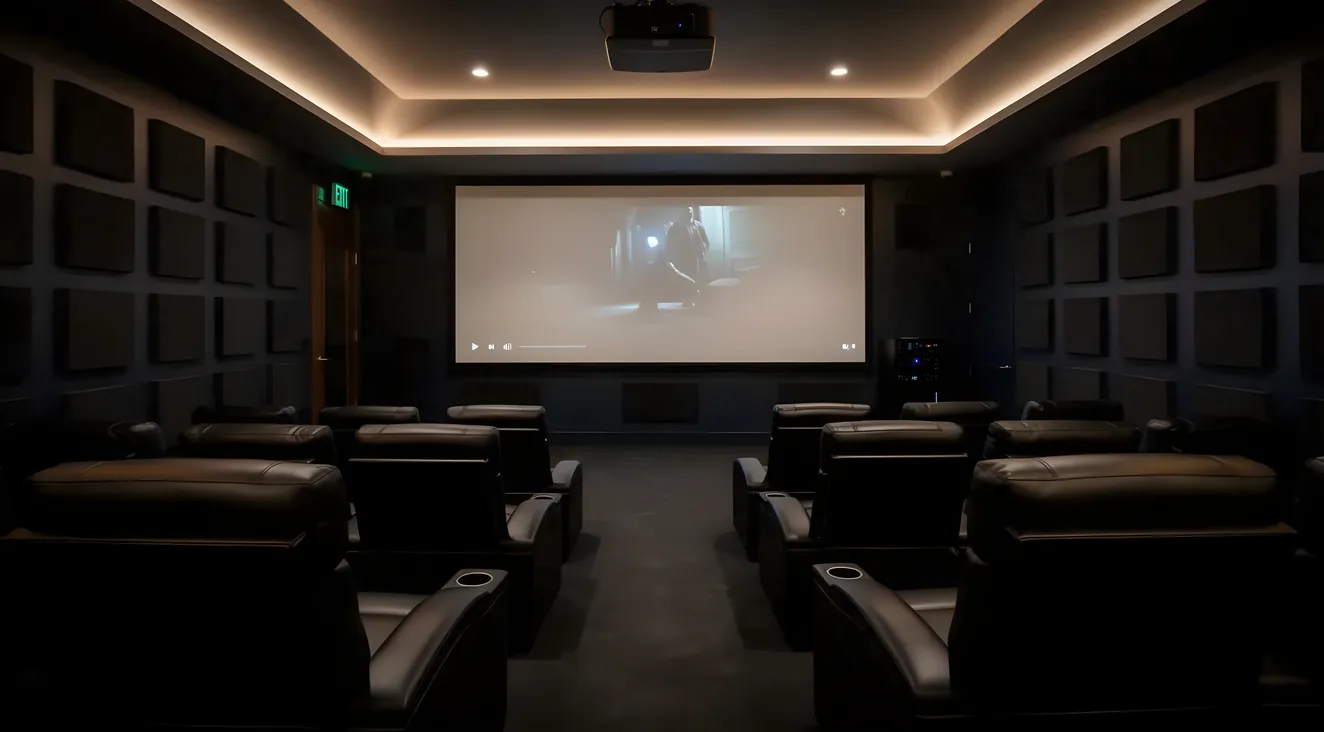
Dedicated theater rooms are purpose-built spaces with no competing function. Seating rows, a front projection system, full acoustic treatment, blackout conditions, and controlled lighting. These take the most planning and budget but deliver the most consistent picture and audio.
Media rooms blend home theater with everyday use. The TV stays on during afternoon sports and late-night movies. Acoustics are treated lightly, if at all. Lighting is adjustable rather than blacked out. An AV receiver handles a soundbar upgrade or a modest 5.1 system. Most Bay Area projects fall here.
Retrofit installations start with an existing room, often a living room or bonus room, and add or upgrade the AV system without major construction. Speaker wire gets fished through existing walls. An in-wall or in-ceiling speaker replaces a bookshelf. A projector drops from the ceiling where a light fixture used to be. Retrofits require more creative problem-solving than new construction but are usually less disruptive.
The Bay Area introduces specific constraints. Many homes in the East Bay, Peninsula, and South Bay date from the 1940s through 1970s. Walls are often plaster over lath rather than drywall. There are no basements. Attic access varies. Conduit routing that's straightforward in a newer home may require more labor in an older one. Local installers who work primarily in the Bay Area know these constraints firsthand and price accordingly.
Finding the Right Installer
Experience matters, but so does what kind. An integrator who builds home theaters regularly thinks differently than one who mostly does security cameras or whole-house networking. Ask for photos of completed theater and media room projects, not just portfolio highlights from their marketing page.
Brand certifications indicate training and vendor relationships. Control4, Crestron, Lutron, and Sonos all have dealer programs with training requirements. CEDIA (Custom Electronic Design and Installation Association) certification signals industry investment. Neither is strictly required for a good result, but both are worth asking about.
Local references are worth more than distant ones. Bay Area homes have their own character, and an installer who has worked in your city or neighborhood has likely already solved the problems your house will present. Ask for references from projects in similar homes, not just similar budgets.
Design capability varies. Some integrators work from your wish list and spec equipment. Others start with a CAD drawing of the room, model speaker placement and sightlines, and present a full proposal before a purchase order exists. For a dedicated theater, design capability is worth paying for.
For a full guide on evaluating AV integrators before you call one, see How to Choose an AV Integrator.
Bay Area Home Theater Installers
The homepage directory lists verified Bay Area companies that offer home theater installation. The list covers companies across the region, from the North Bay to the South Bay and East Bay.
A few companies serving this category include Hermary's in San Carlos, Audio Video Technologies (AVT) in San Ramon, and World of Sound and Vision in Pleasant Hill. Each handles home theater as a core part of their business, not a side service.
When comparing companies, look at service area coverage alongside specialty. An installer based in Concord likely handles Concord and Walnut Creek projects regularly and will be familiar with the housing stock in those cities. See also Walnut Creek for installers serving that area.
Many companies that install home theaters also handle related systems. If you're considering a home theater alongside music throughout the house or smart home integration, look at installers with experience in whole-house audio and home automation as well. Bundling those projects often reduces total cost and eliminates compatibility issues down the road.