How to Plan a Whole-House Audio System
A well-planned whole-house audio system lets you play music in every room of your home, with each space controlled independently. Done right, it disappears into your walls and ceilings while delivering sound you actually want to listen to. Done poorly, it becomes a tangle of cable runs, dead zones, and speakers that don't match the rooms they're in.
This guide walks you through the planning decisions you'll face before the first wire gets pulled.
What Is Whole-House Audio?
Whole-house audio (also called distributed audio or multi-room audio) sends music from one or more sources to speakers throughout your home. Each area of the house becomes a "zone" that can be controlled independently: volume up in the kitchen, muted in the bedroom, the same playlist everywhere, or completely different music in each space.
Modern systems are controlled from a smartphone, a wall-mounted touchscreen, or a voice assistant. A dedicated app lets anyone in the house adjust their zone without touching a receiver or digging through menus.
The core components are:
- Speakers installed in or on the walls and ceilings of each room
- Amplification to power those speakers
- Sources that provide music (streaming services, local libraries, turntables)
- A control system that ties it all together
Room-by-Room Planning
Every room has different requirements. The materials, humidity levels, and listening habits in each space affect which speakers work and how they should be positioned.
Kitchen: In-ceiling speakers stay out of the way during cooking. Choose moisture-resistant models rated for damp locations; steam and grease vapor degrade standard drivers over time. One pair of 6.5-inch speakers centered over the main work area covers most kitchens.
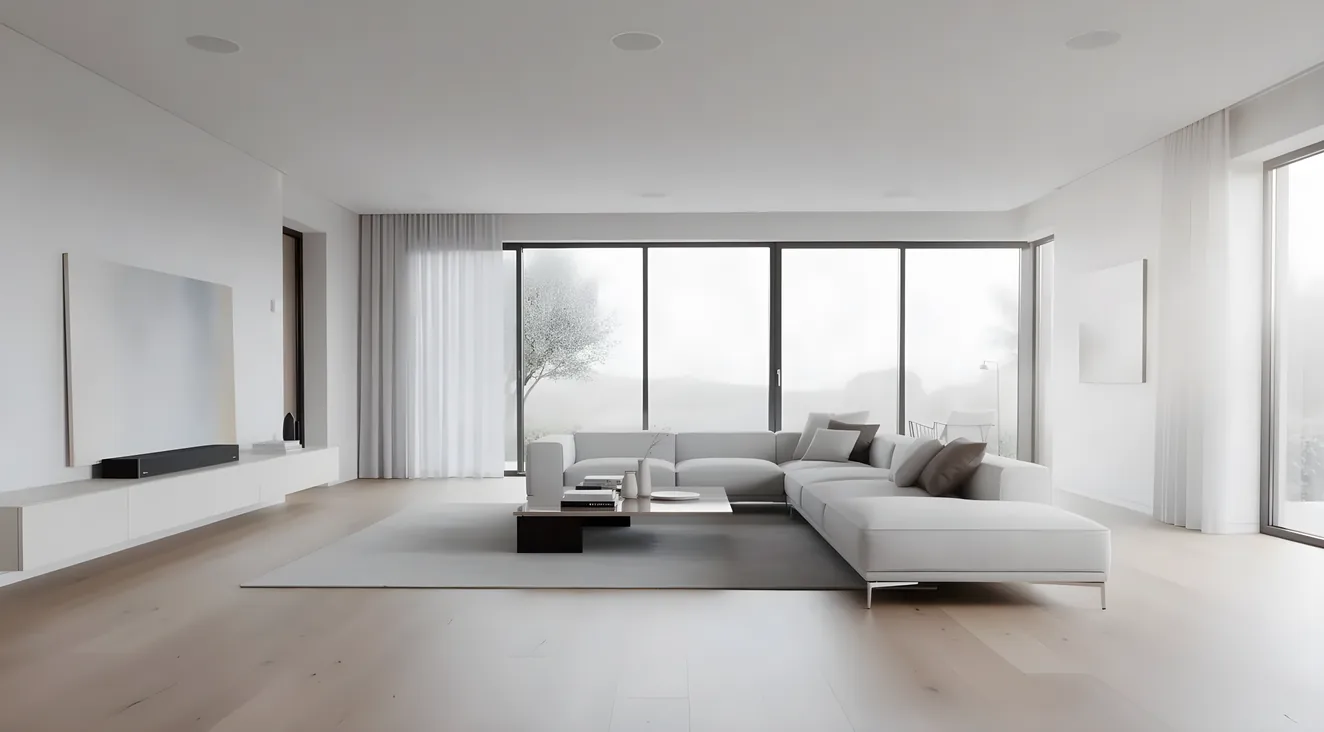
Living Room: The most acoustically demanding space in most homes. In-ceiling speakers work for background music; in-wall speakers offer a more defined stereo image when you're seated. If the living room connects to a home theater, coordinate the two during planning to avoid redundant amplification.
Bedroom: In-ceiling placement keeps the room looking clean. A wall-mounted volume control is worth adding so no one needs to unlock a phone at 2am.
Bathroom: Only use speakers rated for wet or damp environments. Fan noise is a real factor, so choose speakers with enough sensitivity to cut through it.
Outdoor: Landscape speakers blend into garden beds; surface-mount weatherproof speakers on soffits are easier to install and aim. Either way, full weather resistance is required, not just moisture resistance.
Garage and Workshop: Loud environments. Rugged surface-mount speakers aimed at the work area beat in-ceiling placement here. Add a volume control near the door.
Defining Audio Zones
A zone is any area of the home you want to control independently. How you group rooms is a design decision that shapes the whole system.
Some groupings that work well in most Bay Area homes:
- Entertaining zone: Kitchen + dining + living room (often linked for parties, split for daily use)
- Master suite: Bedroom + master bath as a single private zone
- Children's zones: Each bedroom as its own zone with parental volume limits
- Outdoor zone: All outdoor speakers grouped, since they're typically used together
Each zone needs its own amplifier channel and, ideally, a local volume control. Some systems let you control volume only through an app, which works fine until someone's hands are wet or the phone is charging in another room.
Source selection per zone means one room can play a podcast while another plays a radio station. Most modern streaming systems handle this natively. Older matrix-switcher systems required dedicated source inputs and were more rigid.
Speaker Types and Placement
In-ceiling speakers are the most common choice for whole-house audio. Position them centered in the room, or use pairs placed about one-third from each end wall for better stereo separation.
In-wall speakers sit at ear level and produce a more directional stereo image. Good for living rooms and media rooms where you're seated facing one direction.
Surface-mount speakers attach without a cutout and are faster to install. Better for retrofit work where cutting into the ceiling is impractical.
Landscape speakers for outdoor zones come in two forms: satellite-plus-buried-subwoofer (fuller sound) or individual stake-mount pods (easier to reposition).
Avoid placing any speaker in a corner without accounting for bass buildup. Even good equipment sounds muddy when positioned wrong.
Equipment: Amplifiers and Sources
Multi-channel amplifiers are the engine of a distributed audio system. A four-zone system needs eight channels of amplification (two per zone for stereo). Mid-range amplifiers from brands like Russound, Sonance, and Anthem handle this well for most homes.
Streaming sources have largely replaced CD changers and tuners. The main platforms:
- Sonos Amp: Simple setup, strong app. Each unit powers one zone with passive speakers; multiple amps connect over your home network.
- HEOS (Denon/Marantz): Strong integration with Denon AV receivers. Good if you're already in that ecosystem.
- BluOS (NAD, Bluesound): Audiophile-leaning platform with strong hi-res audio support.
Home automation integration: If you have a Control4, Crestron, or Lutron system, your audio should fold into it. Installers who specialize in both can wire everything to a single control interface.
Wiring Considerations
Speaker wire runs from each zone back to a central amplifier location, typically in a utility room, closet, or dedicated AV rack. This is called a "home run" configuration, and it's far more flexible than daisy-chaining speakers.
In new construction, this is straightforward: wire gets pulled during framing before drywall goes up. In the older Craftsman bungalows, Victorian flats, and mid-century homes that make up a significant portion of Bay Area housing stock, retrofit work is more involved. Older homes often have dense insulation, fire blocking in wall cavities, and plaster walls that are harder to patch than drywall.
Key wiring considerations:
- Wire gauge: 16 AWG handles most residential runs. Use 14 AWG for runs over 50 feet.
- Conduit: Adds upfront cost but makes future upgrades far easier. Worth it in new construction or open-wall renovations.
- Central amp location: Multi-channel amps generate heat. Use a ventilated closet, not a sealed cabinet.
- Labeling: Label every run at both ends before drywall closes. Unlabeled bundles are one of the most common service headaches installers see.
Budget Ranges
Whole-house audio costs vary significantly based on the number of zones, speaker quality, and labor involved. Bay Area installation rates tend to run 20-30% higher than national averages.
Basic (4 zones, in-ceiling speakers, streaming source): $3,000-$6,000. This gets you decent in-ceiling speakers in the main living areas, a streaming platform like Sonos, and professional installation. Expect standard quality, good reliability.
Mid-range (8 zones, mixed speaker types, home automation prep): $8,000-$15,000. Adds outdoor speakers, better in-wall options for the living room, higher-grade amplification, and wiring infrastructure for future expansion.
High-end (12+ zones, architectural speakers, full integration): $15,000-$40,000+. Architectural speakers from brands like Sonance, Triad, or Leon are designed to sound exceptional while being nearly invisible. Full Control4 or Crestron integration, conduit infrastructure, and a dedicated equipment rack are standard at this level.
The largest variable in any project is labor. A home that requires extensive fishing of wires through finished walls will cost more than a new build or a major renovation where walls are already open.
Planning Checklist Before You Call an Installer
Before your first conversation with a Bay Area home audio installer, having answers to these questions saves time and helps you get accurate quotes:
- How many rooms do you want audio in?
- Which rooms need independent control, and which can share a zone?
- New construction, renovation, or retrofit into a finished home?
- Do you have an existing home automation system?
- What streaming services do you use?
- Is there a dedicated equipment closet or utility space?
For rooms that will also serve as theater spaces, read the home theater setup guide before finalizing your audio plan. Systems designed together cost less than systems bolted together later.
For projects with outdoor areas, the outdoor entertainment setup guide covers speaker placement and zone design in detail.
See also: Whole-House Audio Installation Services