Outdoor Home Theater and Entertainment Setup Guide
Your Bay Area backyard is usable almost every month of the year. That makes it a genuinely worthwhile place to invest in permanent audio and video, not just a Bluetooth speaker and a borrowed projector. This guide covers what goes into a real outdoor AV installation: display selection, landscape audio, climate factors specific to the Bay Area, power infrastructure, and what different budget levels actually buy you.
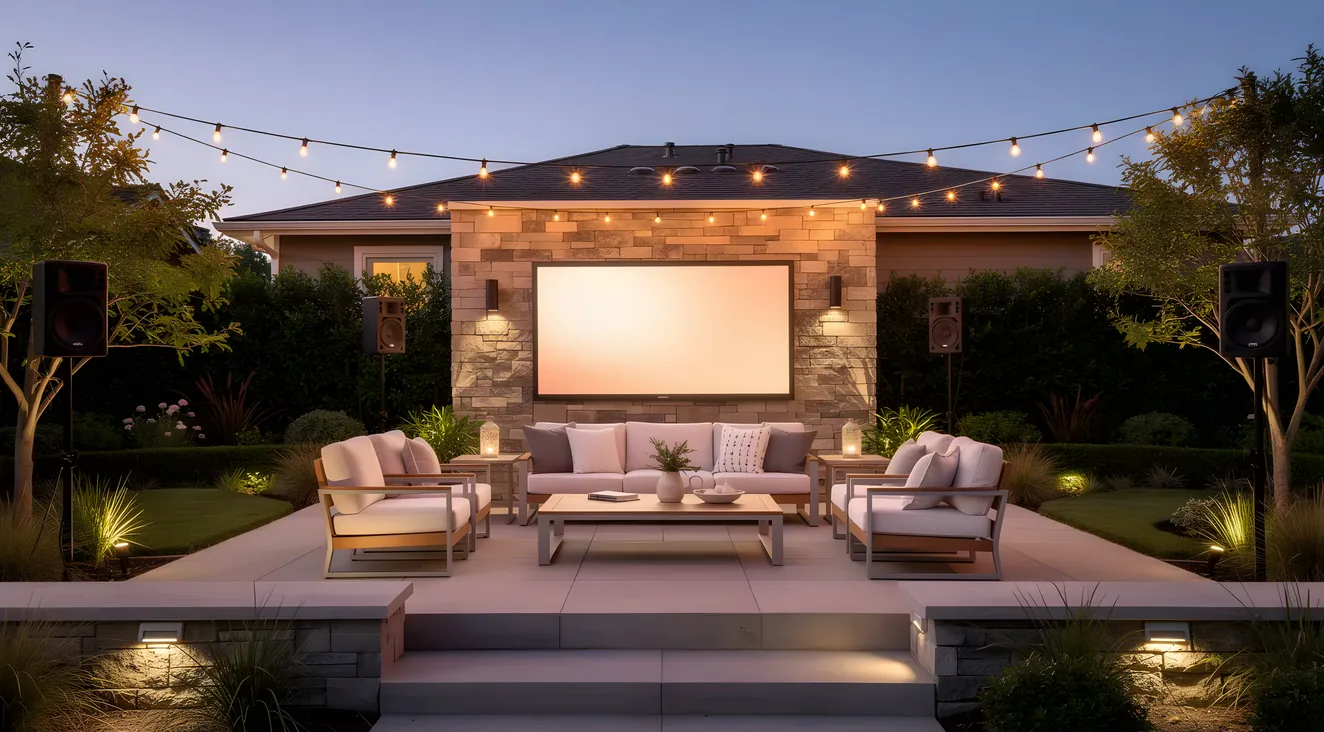
Outdoor AV Options
There are two broad paths for backyard entertainment: portable setups and permanent installations.
Portable setups use a consumer projector aimed at a pull-down or inflatable screen, paired with Bluetooth or battery-powered speakers. They work for occasional movie nights, cost $500-$2,000 to put together, and can be stored when not in use. The tradeoff is picture quality limited by ambient light, audio that doesn't cover a large space well, and the hassle of setup and breakdown every time.
Permanent installations wire everything in place: a weatherized display or projector, in-ground or surface-mounted speakers, dedicated outdoor circuits, and equipment in a protected enclosure. Once installed, you flip a switch. This guide focuses on permanent installations because they're what home theater professionals build and what delivers a reliable experience across seasons.
Choosing an Outdoor Display
Display choice depends on how much sun your space gets and whether you have a covered patio or open sky.
Outdoor-rated TVs are built to handle moisture, temperature swings, and direct sunlight. The two market leaders are SunBrite and Samsung Terrace. SunBrite offers full-sun and partial-sun lines; their Veranda series handles covered patios while the Pro and Platinum lines are designed for direct sun exposure. Samsung Terrace (including the Terrace Frame) targets premium buyers with QLED picture quality and higher sustained brightness. Outdoor-rated TVs run 1,000-4,000 nits versus 250-500 nits for indoor TVs, which matters significantly in afternoon sun. Pricing starts around $1,500 for a 43" entry model and scales to $8,000-plus for large-format full-sun units.
Covered patio TVs are a middle category: regular indoor TVs mounted under a roof overhang with no direct sun or rain exposure. This works in many Bay Area homes with deep overhangs, but humidity from coastal fog can still cause problems over time. A partial-sun outdoor TV costs more upfront but lasts years longer in a wet climate.
Projection systems remain relevant for large-format viewing, 120 inches and above. A quality 4K laser projector aimed at a motorized screen gives you a cinematic image at night or in shade that no fixed TV can match at any price. The limitations: reduced picture quality in ambient light, projector placement requirements, and screen maintenance. Many high-end installations combine a fixed outdoor TV for daytime use and a projector-and-screen setup for evening movies.
Outdoor Audio
Good outdoor audio requires more speakers than you'd expect. Sound dissipates outdoors, so covering a patio or yard well means distributing multiple smaller speakers rather than running one loud unit.
Landscape speaker systems are the standard for true outdoor audio. A typical landscape setup pairs burial-grade subwoofers (placed in the ground to use the earth as an enclosure) with satellite speakers disguised as rocks or garden stones. Brands like Klipsch, Polk Audio, and OSD Audio make rock-style satellites that blend into landscaping at a distance. These systems cover large areas evenly and can be tuned by a professional for consistent sound across a yard.
Surface-mount patio speakers attach to eaves, fences, or pergola beams. They're a cleaner install for covered patios and deliver good audio quality for a defined seating area. Polk Audio's atrium series and Klipsch's AW series are widely used by installers in this region.
Soundbars for covered areas are a cost-effective option when the TV is in a protected location and the listening area is compact. Outdoor-rated soundbars exist (SunBrite makes matching units for their TVs), but a standard indoor soundbar under a fully covered patio can also work. Not recommended for open or coastal locations.
Weather ratings matter for anything exposed to the elements. Look for IP65 or higher for speakers with any outdoor exposure. IP65 means dust-tight and protected against low-pressure water jets from any direction. Subwoofers buried in the ground need UL-listed direct-burial ratings, not just IP ratings.
Bay Area Climate Considerations
The Bay Area's climate is a significant advantage for outdoor AV. Mild temperatures mean outdoor equipment isn't cycling through extreme heat and cold the way it would in Phoenix or Minneapolis. But the region's microclimates create specific challenges that vary by location.
Coastal fog and moisture are the primary concerns for properties near San Francisco, the Marin coast, Oakland hills, and coastal San Mateo. Salt air and persistent moisture accelerate corrosion on metal components and degrade unsealed speakers over time. Equipment for these locations should carry full IP65 ratings, use stainless hardware, and be installed with UV-resistant cabling. A professional familiar with coastal installations will choose different hardware than one who works primarily inland.
East Bay inland heat (Walnut Creek, Pleasanton, Danville, Livermore) creates the opposite problem. Summer afternoons exceed 100 degrees in some microclimates, which stresses electronics and makes full-sun TV brightness requirements more important. Ventilation in equipment enclosures matters more here than on the coast.
Wildfire smoke periods (typically late summer through fall) don't affect electrical equipment directly, but fine particulate can accumulate in equipment vents over time if enclosures aren't properly sealed. Air quality alerts are also the reality of why outdoor installations need to be worth using on the other 300-plus days a year.
Rain protection November through March is relevant even for non-coastal locations. The Bay Area averages 18-25 inches of rain annually, with most of it concentrated in winter months. Equipment in covered locations handles this with no issue. Open installations need waterproof ratings throughout, and equipment enclosures should be rated for direct rain exposure. An installer should verify that outdoor outlets are GFCI-protected and that any equipment cabinet drains or has adequate ventilation to prevent moisture buildup after rain.
Power and Networking
A proper outdoor AV installation runs on dedicated electrical circuits, not extension cords from a sliding door.
Outdoor-rated outlets should be installed at each zone where power is needed: at the display location, at the equipment enclosure, and near seating areas if you're adding lighting or heating. In California, exterior outlets require GFCI (ground fault circuit interrupter) protection per NEC code. A licensed electrician should run these circuits; combining AV installation with an unlicensed electrical rough-in creates both code problems and safety risks.
GFCI requirements apply to all outdoor outlets within 20 feet of a swimming pool and for all outdoor receptacles generally. Bay Area building departments enforce these requirements on permitted work. Any reputable AV installer will either pull the necessary permits or coordinate with a licensed electrician who does.
Wi-Fi to outdoor areas often needs attention before installation. Most home routers don't deliver reliable Wi-Fi signal 50-80 feet away through exterior walls. Options include a Wi-Fi access point mounted on an exterior wall or eave, a mesh network node placed near a window facing the backyard, or a wired Ethernet run to the outdoor equipment location with a dedicated outdoor access point. For streaming video outdoors, a stable connection matters more than raw speed.
Weatherproof equipment enclosures house the AV receiver, streaming devices, and any amplifiers. Purpose-built outdoor AV enclosures are available from companies like SunBrite and Peerless, or a custom solution can be built from NEMA-rated electrical enclosures. The enclosure needs ventilation (with filtered vents, not open holes), cable entry points with weatherproof grommets, and ideally a surge protector inside.
Budget Ranges
Outdoor AV installations vary widely based on display size, audio scope, and site complexity.
Basic patio setup: $2,000-$5,000. A covered patio TV in the 55-65" range, two to four surface-mount patio speakers, a streaming device, and a basic AV receiver. Minimal electrical work, existing Wi-Fi reaches the area. This is the entry point for permanent outdoor entertainment and suits smaller covered patios.
Mid-range outdoor theater: $5,000-$15,000. A full-sun outdoor TV (65-85"), a 4-6 speaker landscape audio system with subwoofer, a weatherproof equipment enclosure, dedicated outdoor electrical circuits, and Wi-Fi infrastructure. Suitable for a typical suburban backyard with an uncovered or semi-covered seating area. This is the most common scope for Bay Area single-family homes.
High-end landscape audio and outdoor theater: $15,000-$40,000+. This tier adds projector-and-screen capability alongside a fixed display, a full landscape audio system covering the entire property, motorized screen, outdoor lighting integration, smart home control (Lutron, Control4, Crestron), and significant custom fabrication. Larger properties and pools push costs higher. Estate installations can exceed $60,000 when custom cabinetry, integrated pool audio, and premium display technology are included.
These ranges include equipment and professional installation. DIY approaches reduce cost but often result in equipment choices that aren't rated for the environment, improper electrical work, and audio tuning that doesn't account for outdoor acoustics.
For help finding Bay Area installers who specialize in outdoor AV, see the outdoor AV installation directory. For related projects, the whole-house audio planning guide covers indoor-outdoor audio integration, and the home theater setup guide addresses indoor theater rooms. The homepage has a full index of Bay Area home theater resources.