Home Theater vs. Media Room
If you're planning a major AV upgrade, you've probably heard both terms used interchangeably. They're not the same thing. A dedicated home theater and a media room serve different needs, require different budgets, and suit different homes. Knowing which one fits your situation will save you from investing in the wrong setup.
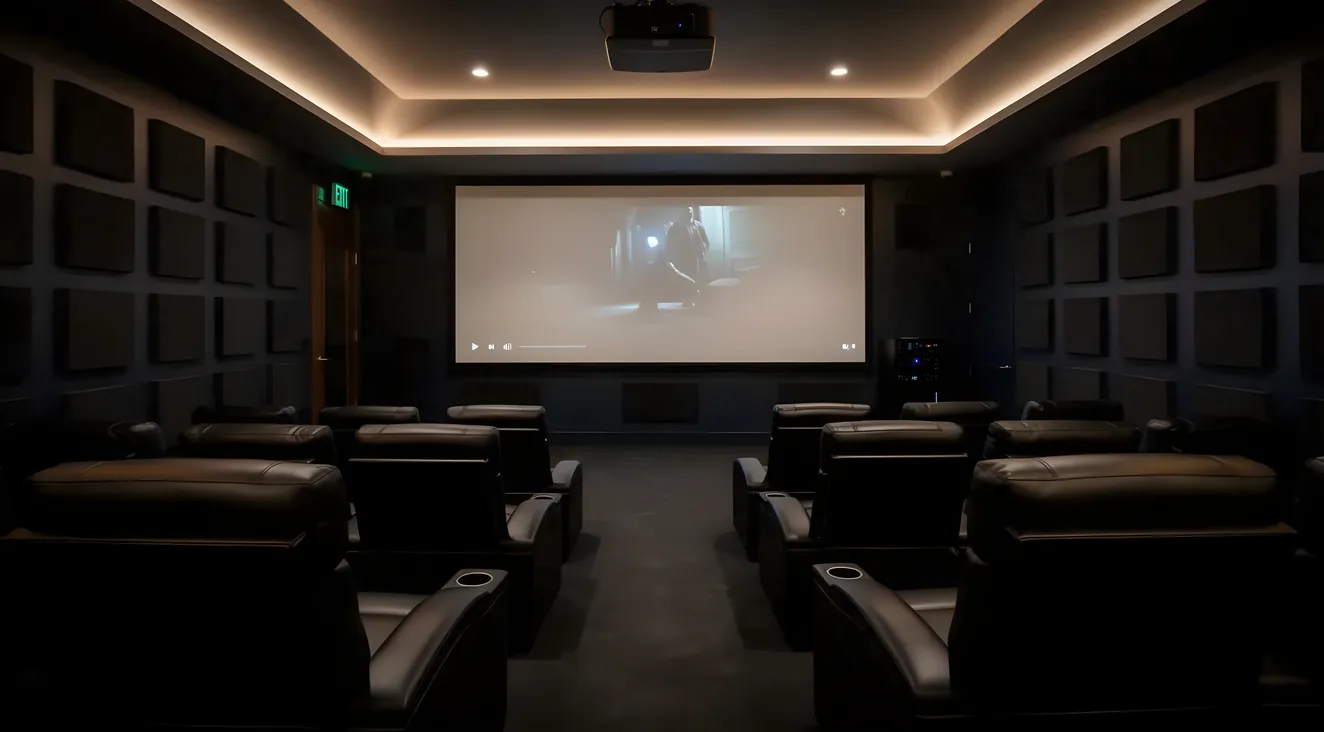
What Is a Dedicated Home Theater?
A dedicated home theater is a purpose-built room designed for one thing: the best possible cinematic experience. Every element of the space is optimized for that goal.
These rooms are typically:
- Fully light-controlled. Blackout walls, no windows, or heavy light-blocking treatments eliminate glare and compete with nothing on screen.
- Acoustically treated. Wall panels, bass traps, and ceiling diffusers control sound reflections so dialogue is clear and the soundstage is accurate.
- Tiered or raked. Rows of dedicated theater seating, often on a raised platform, give every viewer a clean sightline to the screen.
- Projector-and-screen based. A front-projection setup with a 100"+ screen is standard; the room layout is designed around throw distance.
- Single purpose. The room doesn't double as a playroom, gym, or casual TV lounge. When you're in it, you're watching something.
Dedicated theaters deliver an experience comparable to a commercial cinema. The tradeoff is that they demand serious space, serious investment, and a room that's genuinely committed to the cause.
What Is a Media Room?
A media room is a multi-purpose entertainment space. It has good AV equipment, comfortable seating, and an enjoyable viewing experience. It also handles gaming sessions, family movie nights, the big game with friends, and background TV while you fold laundry.
Typical characteristics:
- TV-centric. A large flat-panel display (75" to 85" or larger) rather than a projector and screen.
- Ambient light acceptable. Windows, recessed lights, and general room lighting are present. Blackout conditions aren't a requirement.
- Flexible seating. Sectionals, recliners, or a mix of both. The room can be rearranged or serve other functions.
- Less acoustic treatment. Some soft furnishings help absorb sound, but there's no dedicated acoustic panel installation.
- Shared use. Kids can play in there. Guests hang out. It's a room that happens to have great AV, not a room built exclusively around it.
A well-designed media room can still look and sound excellent. The distinction isn't quality of equipment; it's intent and optimization.
Key Differences
| Factor | Dedicated Home Theater | Media Room |
|---|---|---|
| Cost | $20,000 to $100,000+ | $5,000 to $25,000 |
| Light control | Complete blackout required | Ambient light tolerated |
| Acoustic treatment | Full treatment: panels, traps, diffusers | Minimal (soft furnishings help) |
| Seating | Tiered dedicated seats, fixed layout | Flexible: sectionals, recliners |
| Display type | Projector and screen (100"+) | Large flat-panel TV |
| Room requirements | Dedicated, sealed space | Existing room can be adapted |
| Room flexibility | Single purpose | Multi-use |
| Installation complexity | High: custom construction often needed | Moderate: AV and furniture-focused |
Cost is the sharpest dividing line for most homeowners. A modest home theater starts around $20,000 for a pre-planned space with quality components. Fully custom builds in the Bay Area with premium acoustics, seating, and automation run considerably higher. A media room can be done well for $8,000 to $15,000 depending on display size, audio system, and whether you're finishing an existing space.
Which Is Right for Your Bay Area Home?
Most Bay Area homeowners end up in the media room category, and not because they're compromising. It's a practical match for the housing reality here.
Space is the primary constraint. Bay Area homes, especially in San Francisco, Oakland, Berkeley, and much of the Peninsula, are often smaller than comparable homes elsewhere in the country. A dedicated theater typically needs a minimum of 12' x 20' with at least 9' ceiling height. Many Bay Area homes don't have a room that fits those dimensions unless you're converting a finished basement or a large bonus room.
A few questions to work through:
Do you have a room that can go dark? If you're considering a projector setup, you need a space with controllable light. A room with large east-facing windows and no realistic way to block them points you toward a flat-panel media room.
Who uses the space, and how? Families with kids almost always benefit more from a flexible media room. A dedicated theater works best when it's primarily for adults who want to use it specifically for cinematic viewing.
What's your honest budget? Factor in the full scope: AV equipment, acoustic treatment, seating, wiring, smart home integration, and any construction or finishing work. Bay Area labor rates are among the highest in the country. What sounds like a $15,000 theater project often comes in closer to $30,000 once installation and finishing are included.
If you have the right room and the budget, a dedicated theater is a better long-term investment in pure cinematic quality. For most Bay Area homes, a properly designed media room delivers 80 to 90 percent of the experience at a fraction of the cost.
For a deeper look at what these projects actually cost, see the home theater cost guide.
Can You Have Both?
Sort of. A common approach for Bay Area homeowners is a media room built with theater-grade components: a high-end projector, an acoustically transparent screen, an immersive audio system, and room treatment that works within a flexible space.
This middle-ground setup gives you:
- Projector performance without requiring complete blackout (short-throw projectors and high-gain screens help)
- Substantially better audio than a standard flat-panel setup
- A room that still functions for everyday use
The honest limitation is that you won't match a fully optimized dedicated theater. But if the choice is between "media room with great equipment" and "dedicated theater that doesn't fit my house or budget," the media room wins on practicality.
An experienced home theater installer can help you evaluate your specific space and identify where the best tradeoffs are for your home. What works well in a 1,200-square-foot San Francisco flat looks different from what works in a larger Walnut Creek or San Jose home with a dedicated bonus room.
Whichever direction you go, planning the room around the technology from the beginning produces better results than retrofitting equipment into a finished space. Read the home theater setup guide for more on how to approach the planning process, or return to the directory homepage to browse Bay Area installers by specialty.